Replacing a roof in Northern Virginia is one of the largest home expenses most homeowners face, and most people have no idea what to expect until a contractor is standing in their driveway with a quote. So here is the short answer upfront: most Northern Virginia homeowners pay between $10,000 and $20,000 for a full roof replacement with architectural asphalt shingles, though larger homes, steeper pitches, and premium materials can push that number significantly higher.
What you pay on your specific home depends on a handful of measurable factors: roof size, material choice, pitch complexity, decking condition, and local permit requirements. This guide breaks all of them down so you can budget accurately, spot the difference between a fair quote and a low one, and make a confident decision before signing anything.
Here is what this guide covers:
- What Northern Virginia homeowners actually pay for roof replacements in 2026
- The specific factors that drive costs up or down on your project
- A breakdown of pricing by material type and home size
- Hidden costs that often catch homeowners off guard
- How to evaluate quotes and protect your investment long-term

What Northern Virginia Homeowners Pay in 2026
Roof replacement in Northern Virginia costs more than in most parts of the state, and understanding why helps you evaluate whether the quotes you receive are reasonable. This isn’t a market where a single average captures the full picture. Two homes on the same street in Vienna and surrounding areas can receive quotes thousands of dollars apart, and both can be completely accurate.
Based on current market data, Northern Virginia homeowners in 2026 can expect to pay:
- Standard asphalt shingle roof: $10,000 to $20,000 for a typical single-family home
- Mid-range architectural shingles with premium underlayment: $13,000 to $18,000 for a 2,000 to 2,400 square foot home
- Per square foot: $5 to $10 or more depending on materials and roof complexity
These ranges reflect the Northern Virginia premium. This region consistently ranks as one of the highest-cost roofing markets in the Mid-Atlantic, driven by elevated labor rates, strict county permitting requirements, and HOA coordination in many established communities. A comparable roof replacement in central Virginia might run $1,500 to $3,000 less for the same scope of work.
The Northern Virginia pricing premium exists for concrete reasons:
- Labor rates: Labor makes up 50 to 65% of most roofing jobs in Northern Virginia, meaningfully above the 40 to 55% range typical in surrounding states. Experienced roofing crews in the region command premium wages because demand is high and the labor market is competitive.
- Permitting requirements: Fairfax County, Arlington, Alexandria, and most Northern Virginia jurisdictions require permits for full roof replacements, with fees typically running $100 to $500 depending on project valuation and local requirements.
- HOA oversight: Many established neighborhoods in Vienna and surrounding areas require architectural review before roofing work begins, which adds coordination time and limits some material or color choices.
- Higher property values: Lenders, buyers, and insurers in high-value markets scrutinize roofing quality more carefully, which means contractors working in Northern Virginia are held to a stricter standard of installation and documentation.
6 Biggest Factors That Determine Your Specific Cost
Roof replacement pricing isn’t arbitrary. Every line item on an estimate ties back to a measurable characteristic of your specific home, your chosen materials, and the scope of work required. These six factors account for the vast majority of cost variation between quotes.
1. Roof Size and Square Count
Roofing is measured in squares, where one square equals 100 square feet of roof surface. The total square count is the foundation of every estimate. A small townhome in Vienna might measure 15 to 18 squares. A larger colonial with a complex roofline could reach 30 to 40 squares or more.
To estimate your square count roughly, take your home’s total footprint in square feet, factor in the pitch multiplier for your slope, and divide by 100. Your contractor will measure precisely using drone or aerial measurement tools, which removes the guesswork and prevents disputes over scope.
| Home Type | Typical Roof Size | Estimated Total Cost |
|---|---|---|
| Townhome | 12–18 squares | $8,000–$13,000 |
| Small single-family (under 1,800 sq ft) | 16–22 squares | $10,000–$15,000 |
| Mid-size single-family (1,800–2,600 sq ft) | 22–30 squares | $13,000–$19,000 |
| Large single-family (2,600–3,500 sq ft) | 30–40 squares | $18,000–$26,000 |
| Estate or complex roofline | 40+ squares | $25,000–$45,000+ |
These ranges reflect architectural asphalt shingles with a standard tear-off, and are based on current Northern Virginia labor rates and permit costs. Premium materials: metal, slate, or designer shingles will push totals higher. The six factors below explain what moves your number within or above these ranges.
2. Roofing Material Selection
Material choice is the single largest variable in total project cost after roof size. Lower-priced materials save money on installation day but rarely last as long, so what you pay per year of service matters as much as the sticker price. Here is how the options compare on a 2,000 square foot roof in Northern Virginia.
| Material | Cost per square foot | Cost per square | 2,000 sq ft roof | Lifespan |
|---|---|---|---|---|
| Standard 3-tab asphalt | $4.50 to $6 | $450 to $600 | $9,000 to $12,000 | 15 to 20 years |
| Architectural asphalt | $5 to $9 | $500 to $900 | $10,000 to $18,000 | 25 to 30 years |
| Natural cedar shake | $8 to $14 | $800 to $1,400 | $16,000 to $28,000 | 30 to 40 years |
| Synthetic slate or synthetic cedar shake | $8 to $14 | $800 to $1,400 | $16,000 to $28,000 | 40 to 50 years |
| Standing seam or corrugated metal | $10 to $18 | $1,000 to $1,800 | $20,000 to $36,000 | 40 to 70 years |
| Natural slate or clay tile | $15 to $30 | $1,500 to $3,000 | $30,000 to $60,000 | 50 to 100 years |
- Standard 3-tab asphalt shingles: $4.50 to $6 per square foot. Rarely recommended today due to shorter lifespan and limited wind resistance.
- Architectural (dimensional) asphalt shingles: $5 to $9 per square foot. The most common choice for Northern Virginia homes. CertainTeed Landmark, F-Wave synthetic, and Eco-Star options fall in this range.
- Synthetic slate or synthetic cedar shake: $8 to $14 per square foot. Significantly longer lifespan and improved aesthetics, with better impact resistance than standard asphalt.
- Standing seam or corrugated metal: $10 to $18 per square foot installed. Higher upfront cost but a 40 to 70 year lifespan with minimal maintenance.
- Natural slate or clay tile: $15 to $30 or more per square foot. Premium materials reserved for specific architectural styles.
For most homeowners in Northern Virginia, architectural asphalt shingles from manufacturers like CertainTeed represent the best balance of cost, performance, and warranty coverage for the regional climate.
3. Roof Pitch and Complexity
Steeper roofs require more safety equipment, slower work pace, and additional crew time. Contractors typically add 10 to 20% to their base labor cost for steep-slope applications. A standard gable roof with minimal penetrations is the most straightforward and least expensive to replace. A complex roof with multiple valleys, dormers, skylights, or a cut-up design near chimneys requires significantly more labor hours and precision work.
Here’s what adds complexity and cost:
- Multiple roof planes that require flashing at each valley transition
- Skylights, solar panels, or satellite dishes that must be removed and reinstalled
- Chimneys requiring step flashing and counter-flashing replacement
- Steep pitch above a 7/12 slope requiring additional safety protocols
4. Decking Condition
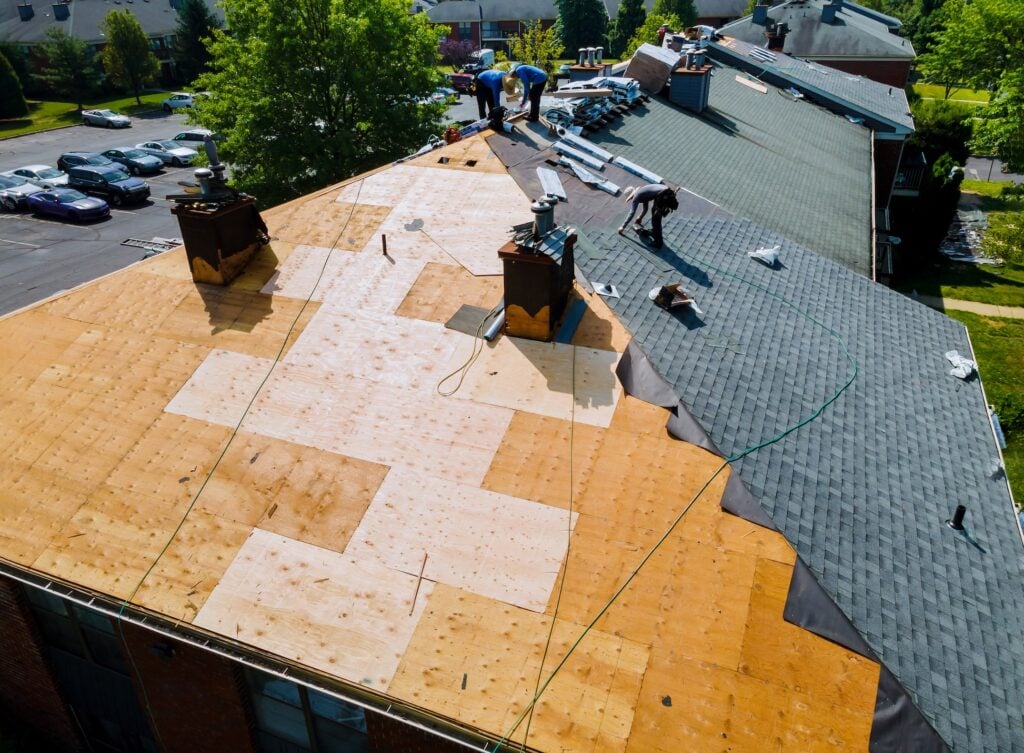
Once old shingles are stripped, the wood decking underneath gets its first full inspection. Roof decking in Northern Virginia homes is exposed to humidity, freeze-thaw cycles, and occasional ice dam conditions that accelerate moisture damage over time. Replacing damaged decking adds $2 to $4 per square foot to the project cost and is never optional. Installing a new roof over compromised wood defeats the purpose of the investment.
A trustworthy contractor will identify decking concerns during the inspection and include a worst-case decking estimate in the written proposal so you know your maximum exposure before work begins. Beware of any contractor who waits until the old roof is stripped to mention potential decking issues for the first time.
5. Tear-Off and Disposal
Some contractors will offer to lay new shingles directly over your existing ones, a process called an overlay, to reduce labor time and disposal costs. While this can lower the immediate price, overlaying existing shingles voids most manufacturer warranties, since proper installation requires a clean deck surface. Virginia building code also prohibits more than two shingle layers on a single roof, which means a home that has already had one overlay has no option but a full tear-off for its next replacement. For these reasons, reputable contractors in the Northern Virginia market treat complete tear-off as the standard practice rather than an upgrade. Disposal of the old material typically adds $1 to $2 per square foot to the project total, a cost that is already included in any honest quote you receive.
6. Ventilation and Underlayment Upgrades
A properly installed roof is a system, not just shingles over wood. Underlayment, ridge vents, soffit intake ventilation, and ice-and-water shield at eaves and valleys are all components that affect both warranty eligibility and long-term performance. Upgrading from standard felt underlayment to a synthetic product adds $0.25 to $0.50 per square foot but significantly improves moisture protection and longevity.
If your attic ventilation is inadequate, installing a new roof without correcting ventilation is a mistake. Poor ventilation traps heat and moisture that degrades shingles from the underside, voids many manufacturer warranties, and accelerates decking deterioration.

What a Full Roof Replacement Includes
When you receive a quote for a roof replacement, you are comparing more than a price; you are comparing scope. Two quotes for “a new roof” can differ by several thousand dollars because one contractor’s standard package includes items the other lists as optional or omits entirely. Here is what a complete, professional roof replacement from Roof Troopers includes as standard:
- Tear-off and disposal of all existing shingles, including haul-away and job-site cleanup
- Full decking inspection once the old material is removed, with replacement of any damaged or soft sections identified during the tear-off
- Ice-and-water shield along all eaves, valleys, and roof penetrations. The critical barrier that protects against wind-driven rain and ice dam infiltration
- Synthetic underlayment across the full roof surface beneath the shingles, providing a secondary moisture barrier
- New drip edge metal along all eave and rake edges to direct water away from the fascia
- Architectural shingles installed to manufacturer specifications
- New flashing at all penetrations: chimney, pipe boots, skylights, and wall transitions
- Ridge cap and ridge ventilation to balance attic airflow and extend shingle life
- Magnetic nail sweep of the yard, driveway, and landscaped areas after completion
- Permit pull with the relevant county building department and coordination of the post-installation inspection
- Manufacturer warranty registration and Roof Troopers’ 10-year workmanship warranty on all labor
When comparing quotes, ask each contractor to confirm which of these items are included as standard versus billed separately. A quote that omits ice-and-water shield, deck inspection, or permit fees is not a lower price; it is an incomplete scope.
Hidden Costs That Catch Homeowners Off Guard
Even experienced homeowners get surprised by line items that didn’t appear in an initial estimate. These are the costs most commonly omitted from first-pass quotes in the Northern Virginia market.
Permit Fees and Inspections
Fairfax County charges $115 to $200 for residential roofing permits based on project valuation. Arlington County runs $100 to $175. Alexandria and Prince William County follow similar processes. Some contractors include permit fees in their quote and some do not. Always confirm in writing before signing a contract. Post-installation inspections are required in most jurisdictions, and your contractor is responsible for scheduling them and ensuring the work passes.
Flashing Replacement
Flashing is the metal that seals transitions at chimneys, walls, skylights, and valleys. Old or corroded flashing should be replaced any time a new roof is installed. Some lower-cost contractors re-use existing flashing to reduce their quoted price. Reusing compromised flashing under a new roof is one of the most common causes of early leak failures on otherwise new installations.
Gutter Detachment and Reinstallation
In many cases, gutters must be removed to allow proper installation of drip edge and starter strips at the eave line. Detaching and reinstalling gutters adds labor time and is sometimes excluded from baseline quotes. Confirm whether gutter work is included before comparing estimates side by side.
HOA Approval Delays
If your home is in an HOA community in Vienna and surrounding areas, architectural review can take one to four weeks depending on how the association processes applications. This doesn’t add direct dollar cost but it does affect project scheduling and may matter if you’re dealing with an active leak or approaching winter.
Roof Replacement Cost by City in Northern Virginia
Northern Virginia is not a uniform market. Labor demand, housing stock, and average home size vary enough across jurisdictions that your zip code meaningfully affects your project total. Below is a breakdown of what roof replacement typically costs across the communities Roof Troopers serves most frequently.
- Springfield: Springfield’s housing stock is dominated by split-levels and colonials built between the 1960s and 1980s, with roof sizes typically falling in the 22-to-32 square range. Most homeowners in Springfield pay between $13,000 and $21,000 for a full architectural shingle replacement. Homes with multiple dormers or complex valley configurations sit toward the upper end of that range.
- McLean: McLean’s larger custom homes and estate-style properties put average roof sizes well above the Northern Virginia norm, frequently reaching 35 to 50 squares or more. Full replacement costs in McLean commonly run from $20,000 to $40,000 depending on material selection and roofline complexity. Premium material upgrades, such as metal standing seam or slate-profile shingles, are more common in this market.
- Falls Church: Falls Church homeowners typically see replacement costs between $12,000 and $22,000. The mix of older colonials and newer infill construction means rooflines and home sizes vary more here than in neighboring jurisdictions. Older homes may carry additional decking repair costs if the original sheathing is board-style rather than plywood.
- Lorton: Lorton’s newer townhome communities and single-family subdivisions generally produce mid-range replacement costs of $10,000 to $18,000. Townhomes with shared roof sections are priced individually by unit scope.
- Arlington: Arlington’s density of older Capes, ramblers, and mid-century colonials, combined with its permit costs, makes it a slightly higher-cost jurisdiction per square foot than the outer suburbs. Homeowners in Arlington typically pay $13,000 to $22,000 for a standard replacement, with older homes more likely to require decking repair that adds to the final total.
- Alexandria: Alexandria’s historic Old Town district includes some of the oldest housing stock in the region, where original board decking and complex architectural details (multiple slopes, slate to shingle conversions, dormers) can push replacement costs above the county average. Outside the historic district, standard replacement runs $12,000 to $20,000 for most homes.
- Vienna: Vienna homeowners in single-family properties typically pay $14,000 to $22,000 for a standard replacement. Larger homes in Vienna Oaks and surrounding neighborhoods can reach $25,000 to $35,000. For a more detailed breakdown of Vienna-specific pricing, see our Roof Replacement Cost in Vienna guide.
- Fairfax: Fairfax city and the surrounding unincorporated Fairfax County area cover a wide range of home types and sizes. Townhomes in Fair Lakes and similar planned communities start at $9,000 to $13,000. Single-family homes in Fair Oaks, Fairfax Station, and similar neighborhoods typically run $14,000 to $22,000.
- Mount Vernon: Mount Vernon’s mix of established single-family neighborhoods produces typical replacement costs of $13,000 to $20,000 for most homes. Waterfront and estate properties along the Potomac can run considerably higher due to size and accessibility factors.
- Fairfax Station: Fairfax Station’s larger lots and custom homes tend to produce higher-than-average project totals. Most homeowners here pay $18,000 to $30,000 depending on home size and material choice.
If your community is not listed above, the most accurate way to know what your specific home will cost is a free on-site estimate. Roof Troopers serves all of the communities above and provides itemized, written quotes with no obligation.
Does a New Roof Increase Home Value in Northern Virginia?
A new roof does add value, but not necessarily in the way most homeowners expect. The annual Remodeling Cost vs. Value report consistently shows that roof replacement recovers a meaningful portion of its cost at resale, typically in the range of 50 to 70 percent of the project cost, though that figure shifts from year to year and varies by market. In practical terms, a $16,000 roof replacement might add $8,000 to $11,000 in resale value on a direct appraisal basis.
The more significant value impact in the Northern Virginia market is what a deteriorating roof costs you at the negotiating table. A failing or aging roof is one of the most common items flagged in home inspection reports, and when it is flagged, buyers routinely request repair credits or price reductions that exceed the cost of a straightforward replacement. A roof that triggers a renegotiation during a sale can cost a seller far more than the replacement would have, and it puts the seller at a disadvantage at the worst possible moment.
For homeowners planning to sell within five years, a proactive replacement with a transferable manufacturer warranty and a workmanship guarantee is often the better financial position. It removes a major inspection objection, strengthens buyer confidence, and in a competitive market like Northern Virginia, allows the home to show without apology.
How to Evaluate Quotes and Protect Your Investment
Getting multiple estimates is smart. Getting three estimates from licensed, insured Virginia Class A Building Contractors and comparing them on the same scope is even smarter. Here’s how to do it right.
Compare Scope, Not Just Price
Two quotes at different price points often reflect different scopes of work rather than different profit margins. Before assuming the lower quote is the better deal, verify that both include the same underlayment specification, the same manufacturer shingles, full flashing replacement, permit fees, and warranty registration.
Verify Licensing and Insurance
Virginia requires contractors performing roofing work to hold a valid Class A or Class B Building Contractor license. Request the license number and verify it through the Virginia Department of Professional and Occupational Regulation. Also confirm the contractor carries both general liability insurance and workers’ compensation coverage. If a worker is injured on your property and the contractor lacks workers’ compensation, you may be exposed to liability.
Understand the Warranty Structure
Material warranties and workmanship warranties are different documents that protect against different risks. CertainTeed’s Landmark series carries a lifetime-limited manufacturer warranty when installed by a credentialed contractor. Roof Troopers backs every installation with a 10-year workmanship pledge on top of the manufacturer warranty, which means if the manufacturer doesn’t honor a covered claim, Roof Troopers will address the workmanship issue directly.
Ask About Financing
A roof replacement in the $12,000 to $18,000 range doesn’t have to be a cash transaction. Roof Troopers offers financing that includes 0% APR for 24 months, fixed rates with flexible terms, and fast online approval with no home equity required. For most Northern Virginia homeowners, this makes it possible to move forward with a quality installation rather than delaying on a roof that is actively deteriorating.
Get an Honest Number for Your Specific Home
General price ranges tell you whether you’re in the right ballpark. A free inspection tells you exactly where you stand. Roof Troopers serves homeowners across Northern Virginia from their Lorton headquarters, including Vienna and surrounding areas and the broader NoVA region. Every inspection uses drone technology for a complete aerial assessment. Every estimate is fully itemized so you can see exactly what you’re paying for before a single shingle is removed.
The team is transparent about repair versus replacement decisions. If your roof has serviceable life remaining, they’ll tell you. If replacement is the right call, they’ll explain exactly why and walk you through the full scope before asking you to sign anything.
When you’re ready to get a real number for your home, contact us today and schedule your free inspection. Roof Troopers will give you the honest assessment your home deserves.
FAQs
How much does roof replacement cost in Northern Virginia?
Most Northern Virginia homeowners pay $10,000 to $20,000 for a full roof replacement with architectural asphalt shingles, or about $500 to $1,000 per square installed. Size and material drive the variation. A small townhome lands near the bottom of that range, a large colonial with steep pitch can pass $30,000.
What is the cheapest roofing material for a replacement?
Standard 3 tab asphalt shingles are the cheapest, at $4.50 to $6 per square foot installed, or roughly $9,000 to $12,000 on a 2,000 square foot roof. Architectural shingles cost $5 to $9 but last 25 to 30 years instead of 15 to 20, so they cost less per year of service.
Does homeowners insurance cover roof replacement in Virginia?
It depends on the cause of damage. Most policies cover replacement if the damage was caused by a covered event like a storm or hail. Wear and tear is generally not covered. Always check with your insurance provider before filing a claim.
How long does a roof replacement take?
Most residential roof replacements in Northern Virginia take one to two days, depending on roof size, complexity, and weather conditions.
Does Virginia require a permit to replace a roof?
Yes. Fairfax County, Arlington, Alexandria, and most Northern Virginia jurisdictions require a permit for a full roof replacement, with fees of $100 to $500 based on project valuation. Your contractor pulls it and schedules the final inspection. Virginia code also caps most roofs at two layers.
Last Updated: August 31st, 2026.
Don’t pay for your roof until 2027!
0% APR, same as cash for 24 months
Get Started Today!
"*" indicates required fields